
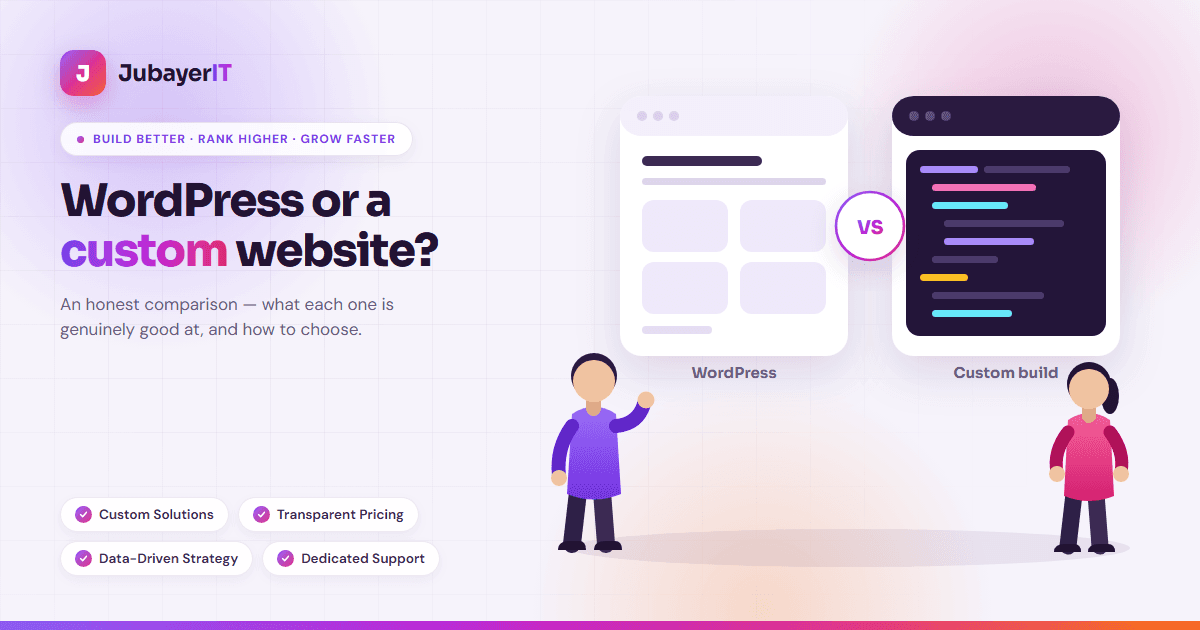
This question comes up in almost every first conversation, and it usually arrives with an assumption attached — either “WordPress is cheap and unprofessional” or “custom is expensive and unnecessary.” Neither is true. They are different tools, and the right answer depends on what the site has to do.
What WordPress is genuinely good at
WordPress powers a large share of the web for real reasons, not just inertia.
- Publishing. If someone non-technical needs to add pages, posts and images every week, WordPress is hard to beat. The editing experience is familiar and nothing needs a developer.
- Speed of delivery. A well-built WordPress site can be live in a fraction of the time a custom build takes, because the plumbing already exists.
- Ecosystem. Bookings, memberships, multilingual content, invoicing, WooCommerce for shops — someone has already solved most common problems.
- Portability. Any WordPress developer can pick it up later. You are not tied to whoever built it.
Where WordPress starts to hurt
The pain is rarely on launch day. It arrives six to eighteen months later.
- Plugin sprawl. Each plugin is code you did not write, loading on pages that may not need it. Twenty of them and the site is slow in a way no caching plugin fixes.
- Maintenance is not optional. Core, theme and plugins all need updating. Skip it and you have a security problem; do it carelessly and you have a broken page. This is ongoing work, and it is the part most quotes quietly leave out.
- Fighting the theme. Once your requirements drift away from what the theme assumed, every change becomes a workaround stacked on a workaround.
- Unusual logic. If your business rules do not resemble anything a plugin was designed for, you end up bending three plugins into a shape none of them wanted.
What a custom build gives you
“Custom” here means a site built as an application — typically with a modern framework — rather than assembled from a theme.
- Only your code runs. Nothing loads that you did not ask for, which is why custom builds tend to hit Core Web Vitals targets more easily.
- The interface fits the work. Instead of adapting your process to a plugin, the screens match how your business actually operates.
- Integrations on your terms. Payment gateways, ERPs, delivery partners, internal tools — connected directly rather than through whatever a plugin happens to support.
- Smaller attack surface. Most WordPress compromises come through an outdated plugin. A custom build has far fewer moving parts to keep patched.
What a custom build costs you
Being honest about the trade: it takes longer, it costs more upfront, and changing content structure later needs a developer unless you pair it with a CMS. If nobody has explained those three things to you, you are not getting the full picture.
A straight way to choose
Answer these about the next two years, not about today.
- Who edits, and how often? Weekly updates by a non-technical person points to WordPress or a headless CMS. Rare changes point to custom.
- Does an off-the-shelf plugin already do the hard part? If yes, and you would not need to modify it much, WordPress is the cheaper honest answer.
- Is the site a brochure or a tool? Brochures and blogs suit WordPress. Anything where users log in, calculate, book against real inventory or follow a multi-step process leans custom.
- How much traffic, and how much does slowness cost you? High traffic with real revenue attached justifies the control a custom build gives.
- Who maintains it? If nobody will own monthly updates, a custom build with fewer dependencies is the safer choice.
The option most people miss
It is not actually a binary. A headless setup keeps a friendly editing interface — WordPress or a hosted CMS — and renders the public site with a modern framework. The marketing team keeps publishing without help, and visitors get a fast custom front end. It costs more than plain WordPress and less than a fully bespoke application, and for content-heavy business sites it is often the best fit of the three.
What we would tell you
We build both, so we have no reason to push you either way. Most small business and local service sites are well served by WordPress built carefully — a light theme, few plugins, and a maintenance plan that someone actually follows. Sites where the website is the product usually justify a custom build.
The wrong answer is choosing on price alone and discovering the constraint a year in, when moving is expensive. If you want a second opinion on which side your project falls, tell us what the site has to do and we will say so plainly.